
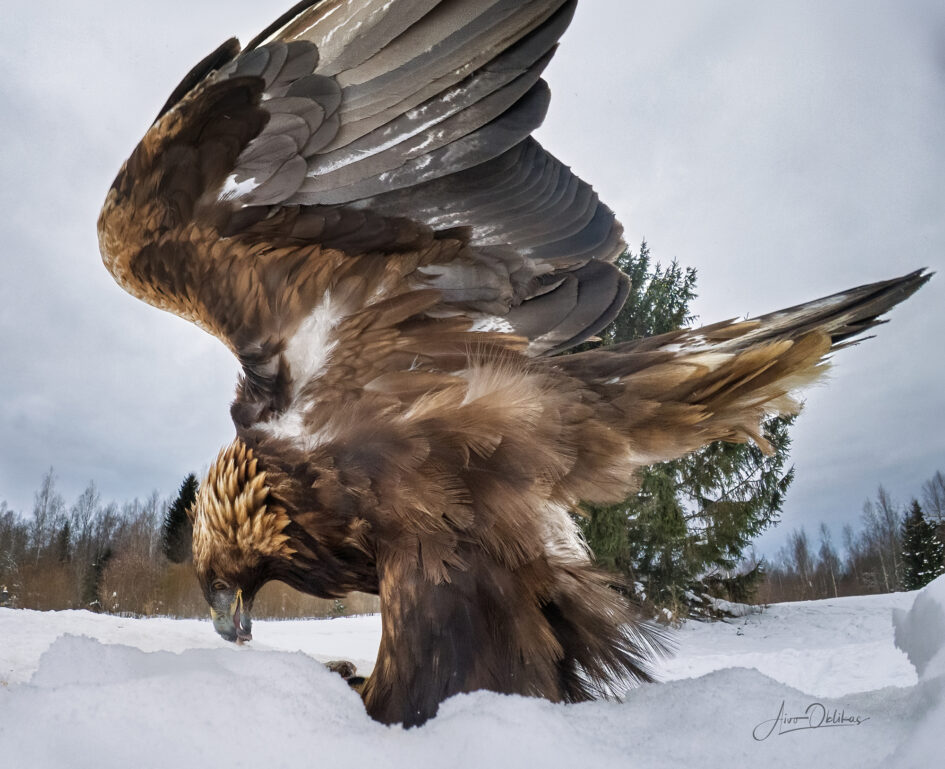

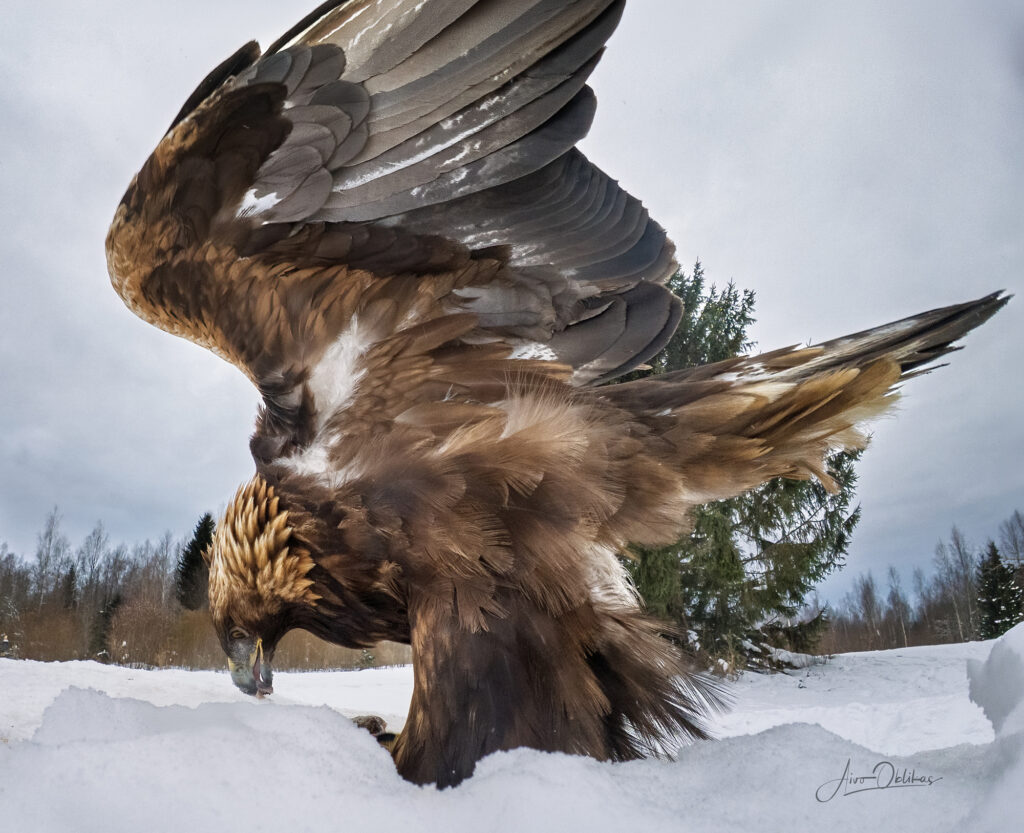
In the spring of 2024, I had a plan to make some wide angle eagles photography. With wide lens, I mean a lens between 12 and 16 mm. Classically, birds and eagles are photographed with a long lens. That is around 300 – 600 mm. With a longer lens, you can be as far away from the bird as possible and take pictures of it. Shooting with a wide lens means that I place a camera with a wide-angle lens in front of it where an eagle could supposedly come. Camera should be about 30-40 cm away from the possible location of the eagle. I’m hiding myself and when the bird is in a place where I want to take a picture, I control the camera over Wi-Fi. When shooting with a wide-angle lens, distortion occurs in the image, i.e. if you sit on the ground and the camera is at your feet, this distortion stretches your legs disproportionately long and the body seems very small in the distance. But why would you want to photograph a bird with such distortion. There are several reasons for this.
Why photograph an eagle with a wide-angle lens?
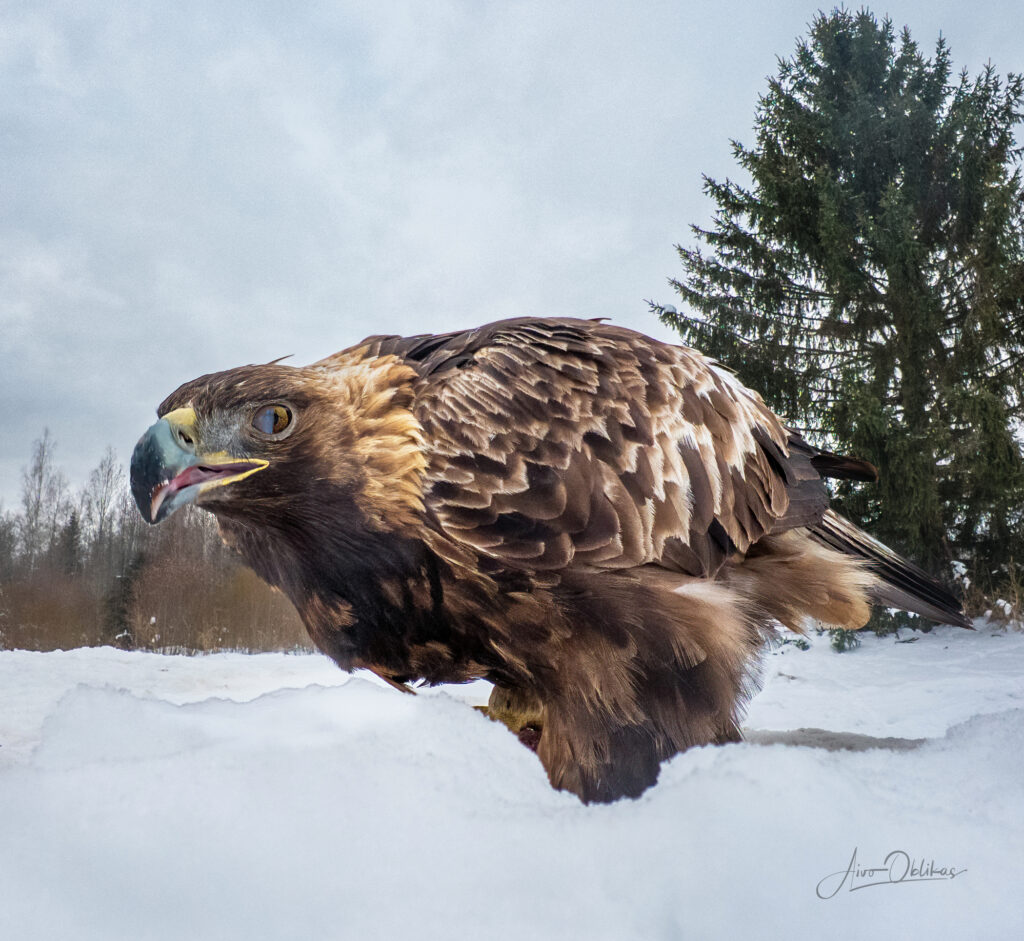
First of all, it gives the bird a completely different perspective. From such an angle, it is actually not possible for anyone to see an eagle in real life like this. When you look at an eagle with binoculars, you see the eagle in the same way as when you take pictures with a telephoto lens. Also, when walking in the zoo, you can see the eagle in a similar way. But in the way shooting with a wide lens, you will never be able to see an eagle. I’ll tell you in advance that I also got shots of the eagle where the picture was taken of the eagle at the moment when the tail moves over the camera.
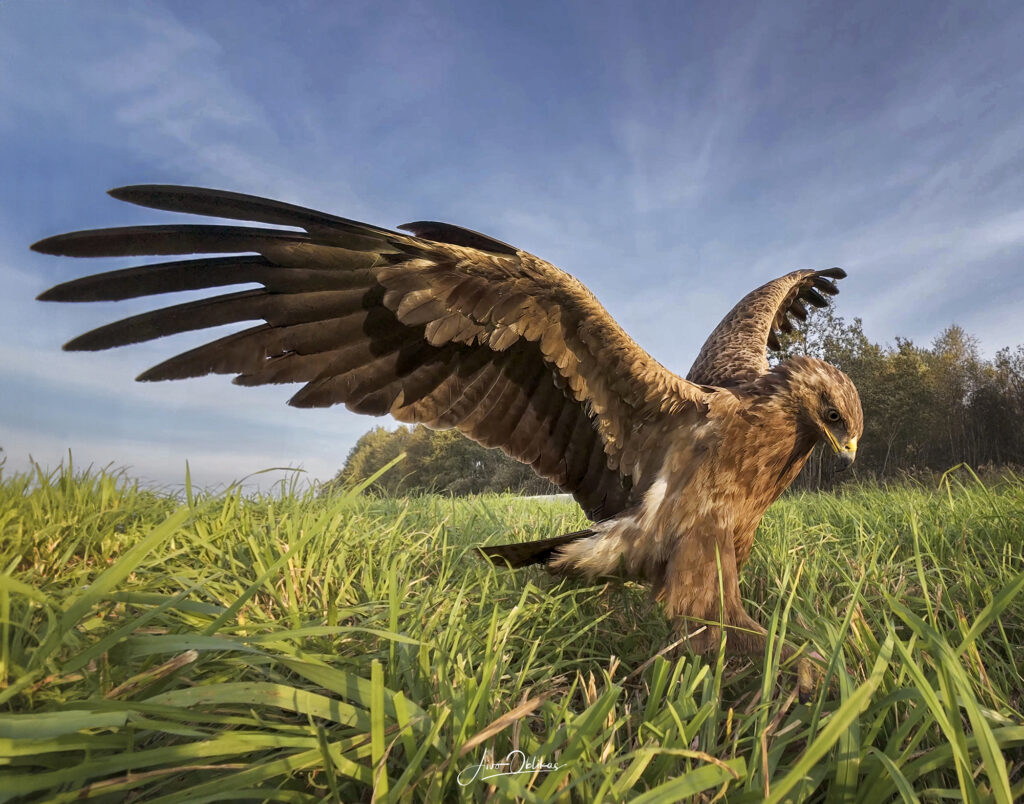
Secondly, this distortion strongly amplifies the dynamics of the bird’s movements. In other words, when a bird turns or stretches its wing or lifts its leg, the amplitude of its movement seems immensely larger, and therefore the dynamics become even greater. An eagle photographed in this way looks even more powerful.
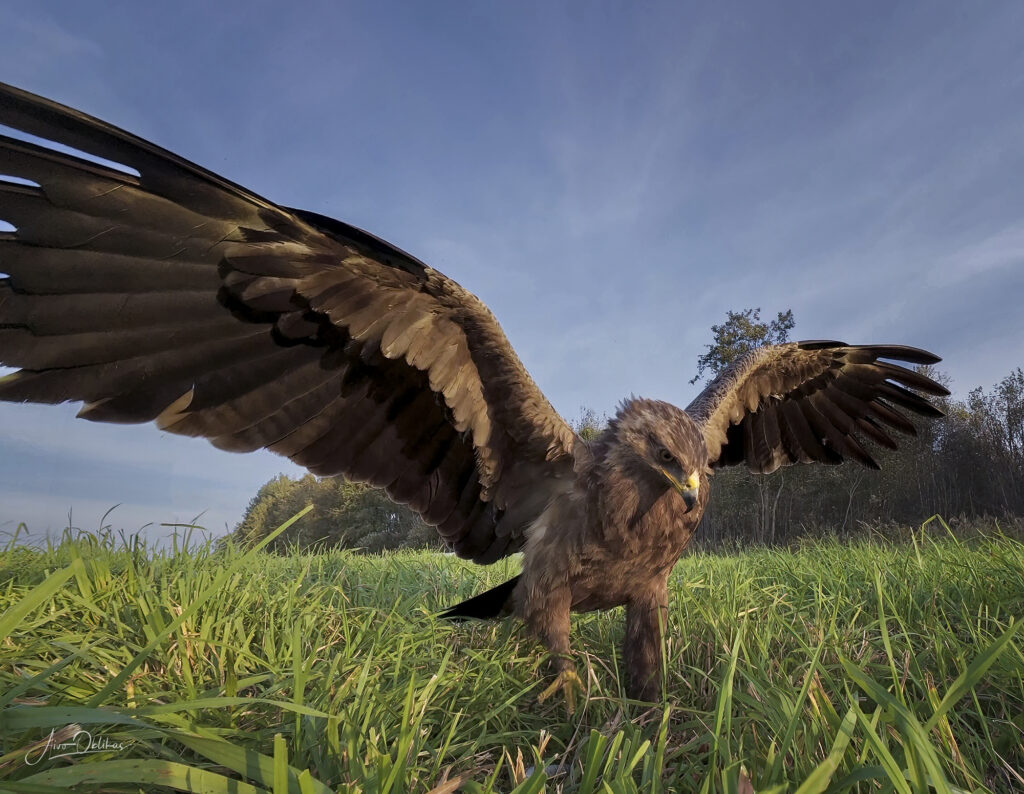
Thirdly, it was very exciting for me to strain my brain and work with such a goal to get something in the picture, so to speak, seems impossible. Since this work was really long and it was accompanied by quite a lot of setbacks in addition to the insane amount of hours spent in the hides, it is a bit like a marathon run. I had to replan and start all over again, etc. And when you finally get a picture, it’s a mega good feeling.
Why is photographing an eagle with a wide-angle lens difficult?
So what is this great work about? The eagle has such good eyesight that it can see, for example, a hare from a distance of more than 3 km. Or an eagle would see an ant sitting on the ground on a 10 floor building roof. And at the same time, it is very sensitive, so every small change immediately causes a problem. If the golden eagle will see even small change in front of the hide, the eagle may not come for days.
I started experimenting with a lesser spotted eagle in spring. Since I had previously photographed the lesser spotted eagle in one area from the hide and the place was not very far away, it was a bit easier to experiment because I could use my previous information about the eagle, its behavior and other things and it was not too time consuming.
As I said, the eagle is an very sensitive bird, so when I had a plan to photograph a lesser spotted eagle with a wide lens, I had to start by getting the bird used to the camera on the site. This means that I placed a camera in front of the hide in a desired place and in order for the bird to get used to it, I let it stay there for several weeks. The eagle went there to eat from time to time and got used to a camera.
The eagle got used to the camera.
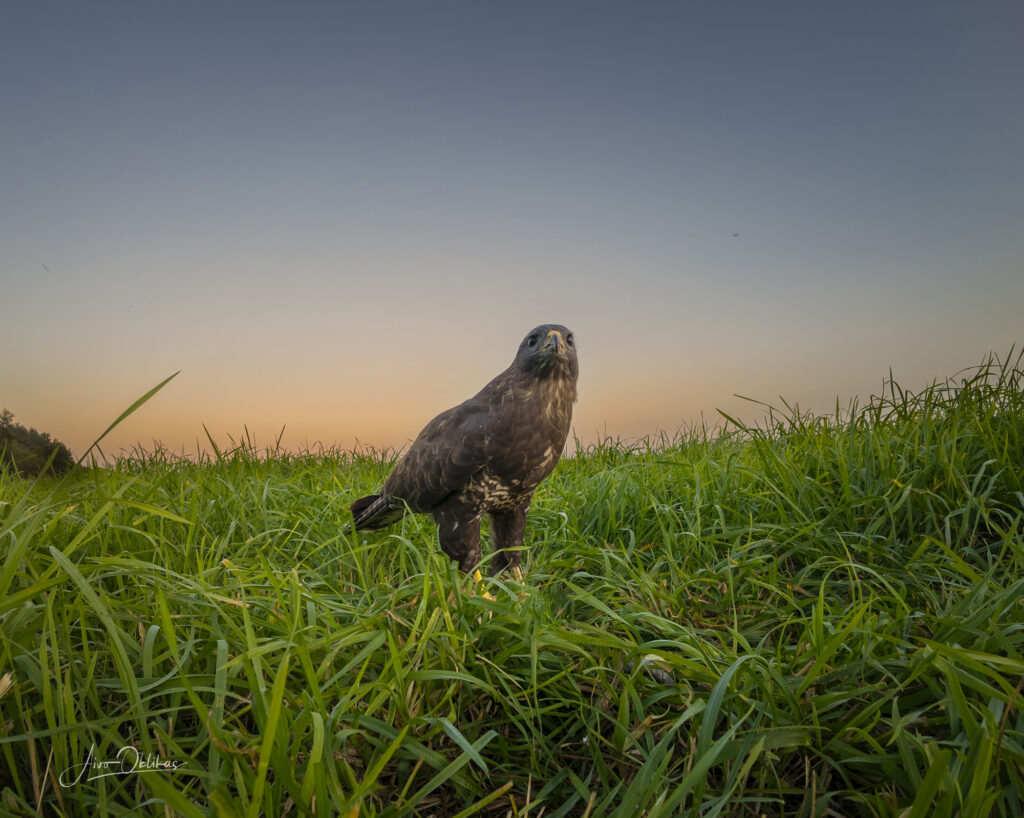
At one point I realized that the camera no longer disturbs the eagle. I came to take pictures full of hope and with high expectations. The common buzzard was the first to land in front of the camera, saw the camera and left immediately. Since I had another camera on the site, there were certain details that I had not taken into account and it frightened the bird. It’s funny in its own way that some details that you don’t even know how to pay attention to are disturbing for a bird of prey. I immediately gathered my things and left so as not to frighten the eagle.
It was necessary to rethink again
I made changes to the camera on the site. And again I accustomed the bird to the changes. It is important to note here that if you photograph summer eagles from the hide, it is not at all as easy as with winter eagles. The reason for this is, that if I put something good for birds so that they would come there, then in reality the fields and meadows are full of prey and it does not often come to the hide. In addition, foxes are very eager to eat what is offered.
When I could see that the eagle was getting used to the changes I had made, I went to take pictures. Now the camera I was using was exactly the same as the one on the site. Of course, I had high expectations again. Everything was awesome, the eagle came. I took the first shot, the eagle was frightened and I was back to zero. The frame I got isn’t even worth showing. Once again, I was in a situation where something had to be done, because something was not working. I made changes again.
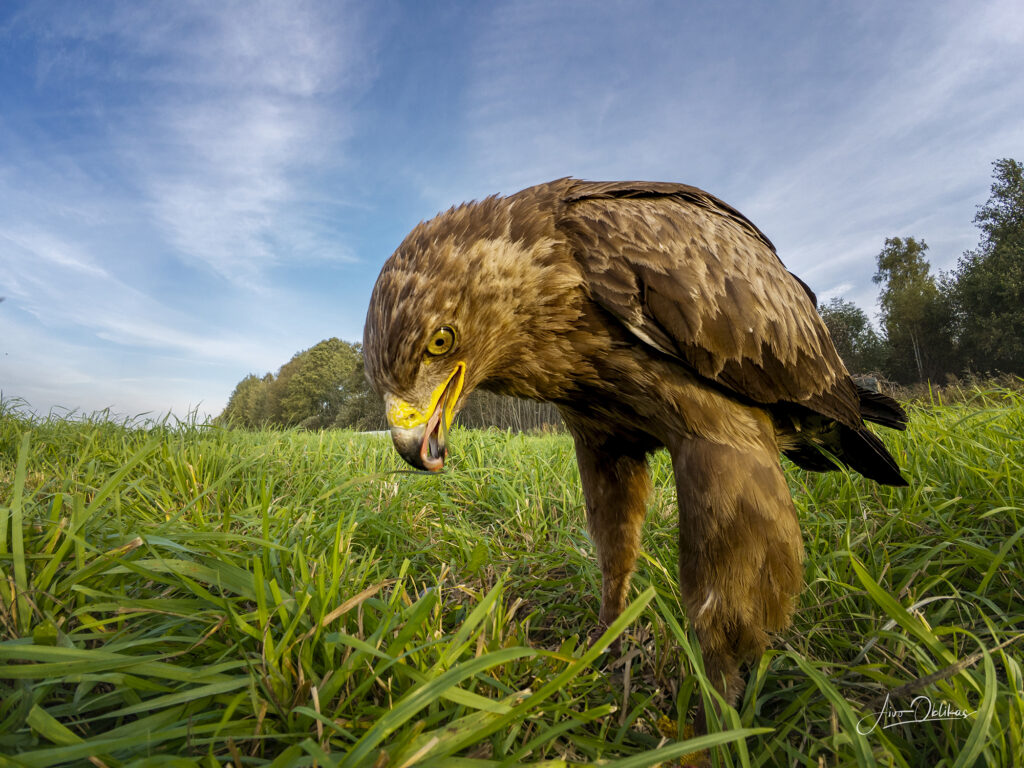
Basically, this work lasted the whole summer, so I started in May and just before the lesser spotted eagles went on their migration, I finally got the pictures in September. Well, I honestly admit that I was super happy. I can’t say whether the feeling of happiness was caused by the fact that I had received exciting pictures or rather by the fact that such a long-term work achieved some kind of result. If I add up the time spent purely in the hide + the time spent on planning the construction, it comes to 3 working weeks, i.e. as if I had done 15 eight-hour working days (over 100 hours in total). In retrospect, there was a lot of sitting in a hide for nothing.
I also wanted to photograph the golden eagle in a similar way.
Success gave rise to new plans and ideas, and there was a desire to get similar pictures of the golden eagle. After all, the golden eagle is, in a way, like the king of birds. A powerful bird of prey that is extremely cautious and catching it beautifully with a longer lens is already very satisfying. However, it was a leap into a whole new world. As much as I was photo shooting golden eagle from rental hide, I can’t use a copy of the camera. In other words, I can’t leave something that standing on the site, because it would disturb other photographers and the owner of the hide. Therefore, it was necessary to approach from a different angle, i.e. to find a solution that could be camouflaged in such a way that it would not interfere with the eagle when placed on the site. Sitting in the hide, I could then work with wifi.
I have been photographing eagles for almost 10 years and I have really enjoyed watching these magnificent birds. In addition to Estonia, I have photographed eagles in many other countries and in the course of that I have gained quite a lot of experience of the behavior of birds of prey. At the same time, I have observed and photographed other birds of prey quite a lot. It has been kind of like the university of life, i.e. observing birds of prey, I have developed a pretty good sense of their behavior and so-called mindset. Today, observing a bird of prey, I can tell with 100% accuracy what it will do next. His body language and behavior are so understandable to me. Having messed around with the lesser spotted eagle and the camera for the whole summer, I had got quite a understanding in this area as well. Taking all this knowledge, I hoped to outplay the golden eagle. This, however, means that there is one of the smartest and most cautious birds of prey in the bird kingdom. In the winter of 2024 – 2025, I made two trips to the hide, where I tried my ideas. I approached the final goal very cautiously, wanting not to frighten the eagle. I tested everything with distant location and with other birds, etc. I would say right away that compared to the photographs of the spotted eagle, it was quite a challenge. Several completely new factors emerged that were absolutely not important when photographing the spotted eagle in the summer. I actually didn’t expect to get anything from these two times except the experience, on the basis of which I could develop further. The winter was over and my two trips had not produced a single photo, but a lot of experience and ideas.
A new summer and new ideas for photographing the spotted eagle
Spring came again and I wanted to try to move on with the lesser spotted eagle to get something a little better. After all, last summer (2024) had only given me this one and last opportunity. Since the starting point was better from the start and I was able to start from where I left off last summer. I started again in April. It’s completely crazy how I spent the whole summer again and towards the end of the season I finally managed to get some shots. This time, the problem was not related to the camera, but to nature itself. Last summer was extremely rainy and I saw many times more frogs in nature than in previous summers. I don’t know if the reason was that there was so much of prey or the weather conditions, but the eagle came into my hides much less and much more irregularly. Compared to the winter eagle, summer eagles are less regular in their coming. The biggest problem, however, was the fox, which had probably built a burrow for itself somewhere nearby. That’s why he was a regular guest in front of my hide. Before, the fox used to come earlier in the morning and in the evening when it got dark, but now it came like a watchman every few hours. This meant that on the one hand, he was happy to take away what I offered to the eagles, but in addition, there were several times such a strange thing that he took a camera with him, which I then searched for in the field. This, however, meant that there were times when an eagle arrived, but the fox had already eaten the treat and the eagle left without coming back for several days. And at the same time, there were times when I sometimes had the camera in place and sometimes not, which caused a certain problem to the eagle. And with all this activity, there was an insane number of hours of sitting in a hide, where no one came in front of the hide while wiping the sweat in the warm summer hide.
Autumn is coming again and I get the only photos of the spotted eagle
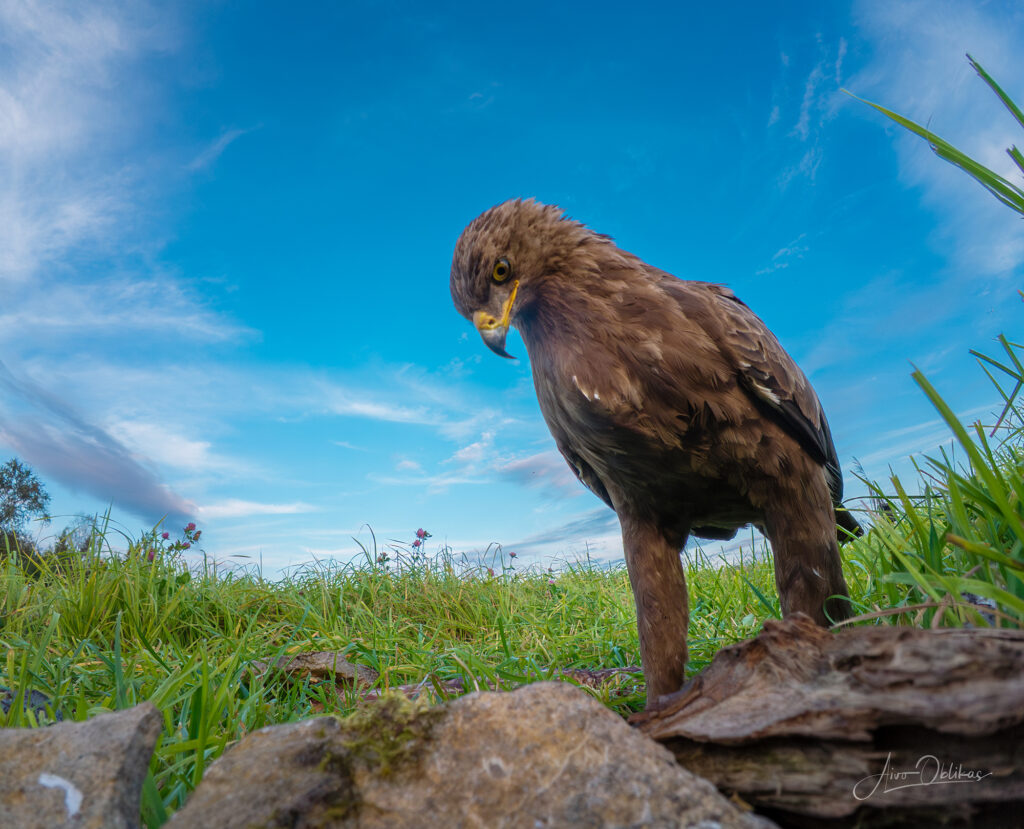
The summer rolled over again in such a way that I got pictures of the spotted eagle on two evenings just before they left. In a way, it was funny that what seemed like a very simple undertaking in the spring became so complicated again and by the end of the summer I had those few shots again. I can only say that years are not brothers. Therefore, the joy of these shots was again great. In other words, it’s a bit of the same thing that when you work so hard, you’re extremely happy with result.
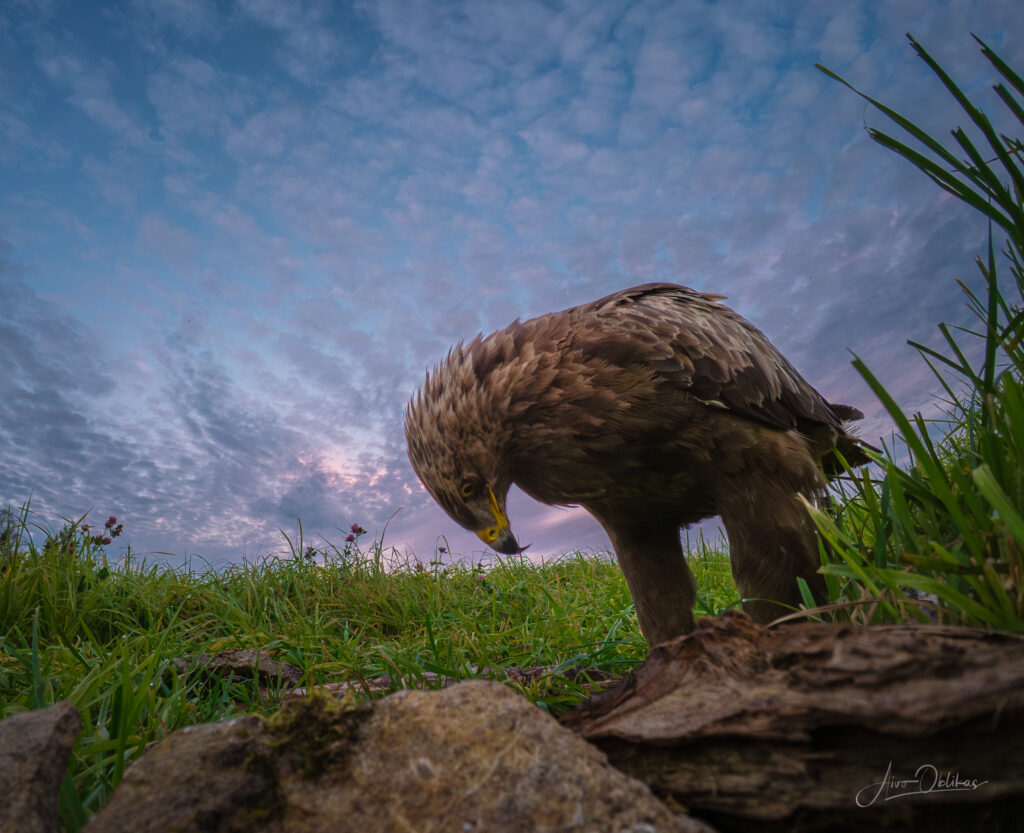
A new winter and I’m still experimenting with photographing golden eagles
Now a new winter has come again, i.e. the winter of 2025-2026. I wanted to continue with the golden eagle from the same place where I finished a year ago. On the first, I made quite big changes to gear compared to the previous two times. I wanted to see what such a step would bring. The experience was extremely positive, i.e. my step did not interfere with the jay and ravens, of which I got quite a few pictures. It didn’t bother the golden eagle either. True, my camera was positioned in such a way that jays and ravens came to my camera on their own, but the golden eagle was doing its business further away. In other words, I didn’t go to disturb him. It was just positive to see that such a sensitive bird as the golden eagle did not let itself be disturbed by the fact that there was something a little further away that is not there daily. Consequently, my disguise had worked well, otherwise the golden eagle would not have landed at all.
When it comes to the sensitivity of the golden eagle, a year ago I was significantly surprised. A deer that had been hit by a car was placed in front of the hide. Since the birds have a hard time with food in winter, I assumed that the birds would be there immediately. On the first day, when the carcass of the roe deer lay there, not a single bird dared to come upon the roe deer. In other words, even though it was food, it had appeared on the site so unexpectedly that it frightened the birds. A significant change in the environment occurred. After all, a deer is a big piece for an eagle as well. On the second day after lunch, the first ravens dared to land at the carcass. On the third day I was in the hide myself and the ravens were already there in the morning. To my disappointment, however, the golden eagle only made a couple of overflights and did not dare to come to eat. It was not until the fourth day that he came to eat.
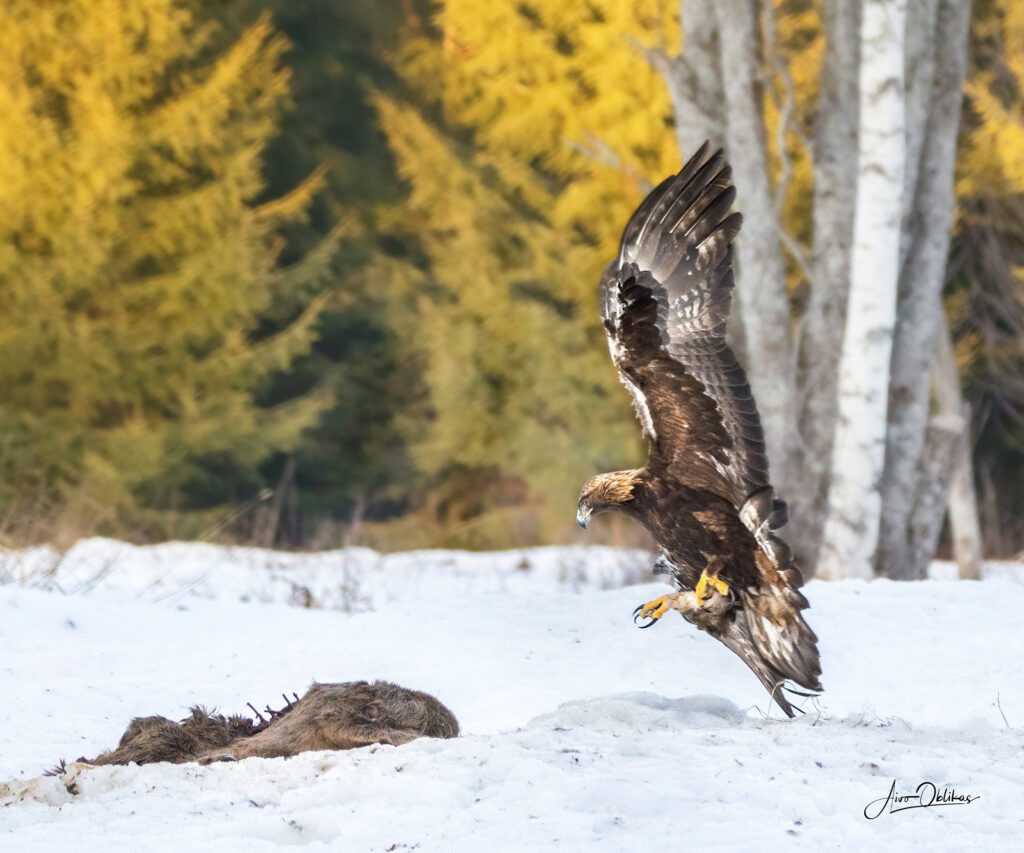
I had to improve the camera and camouflage to get the picture.
This was my fourth trip to the shelter of a golden eagle in two winters with the intention of getting a picture of the king of the forests. I had tested and developed the approach for two summers with a spotted eagle and now I have developed it for two more winters with a golden eagle. Now was the moment of truth. My hopes were high, as the whole thing was polished to perfection. But there was still some uncertainty, and luck had to be on my side as well. First, because knowing the circumstances, I had considered the eagle will arrive from a certain angle and its stay in a certain place. Everything was built up this way. Another lucky factor was that the eagle would come at all.
As I mentioned before, I made my moves so that there was no one else in the hide and so that I wouldn’t cause any problems to anyone. This meant that I had gone into the hide quite so-called with a short notice, so to speak the next day, to be sure that no one else is there. This also meant planning the rest of my life accordingly. The weather should also be highlighted as a lucky factor. If you place a camera outside, you don’t need much. A small snowfall or a stronger gust of wind is enough to cause distracting snow on the lens.
The eagle arrived
At one point, a golden eagle landed on top of the tree and began to explore the ground. I knew that if everything is fine, he would come off the next moment. Beforehand, they look at their surroundings and make sure that everything is safe. My pulse watch managed to give me a message several times to relax, because my heart rate was still very high and I was holding my breath. The minutes still flow very slowly. It’s kind of cool to remember how I watched every turn of his head in such a way that I wondered if there was something different than usual. Is there anything bothering him? It was very difficult to understand that something was interfering, but the bird was in no hurry to land.
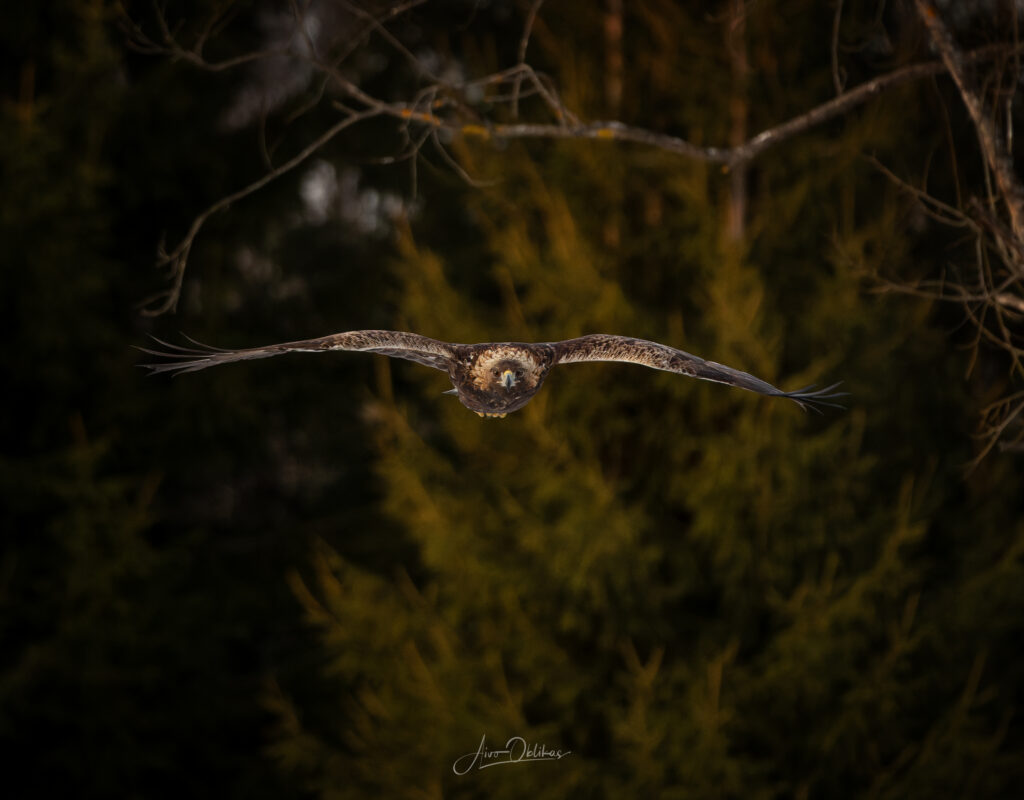
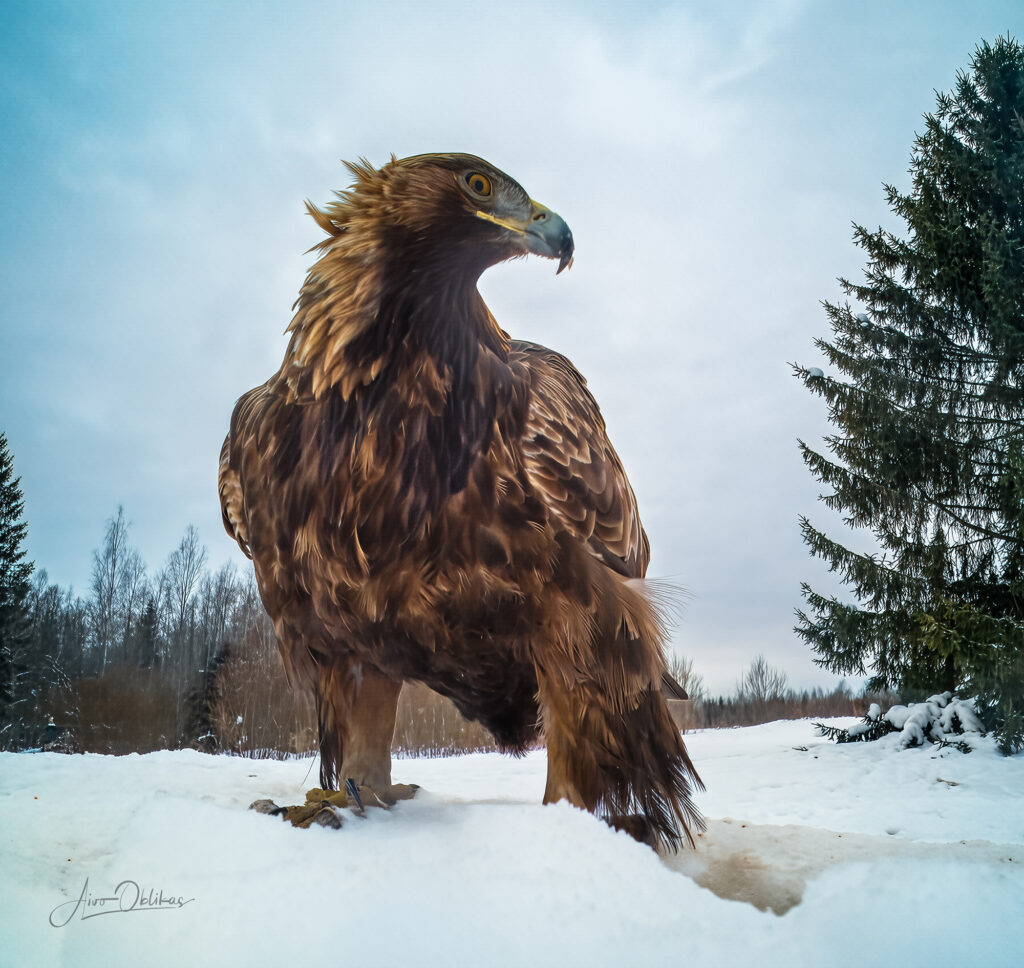
Finally, there was a moment when he glided down. It came with a small arc and from the right direction for me. I knew that everything was fine at the moment, but what would happen next when he will land. Grounding. His eyes went in circles and checked the situation. My heart rate was in a whole new dimension. The watch advised Relax. His gaze moved across the camera and I realized that he didn’t notice it. That gave me the opportunity to take pictures. It’s a mega great feeling. It feels like you’ve been playing chess with a master and at one point you feel like you’re equal to him. Just for a moment, because you know that he is the master and you are just an aspirant. But that moment is enough.
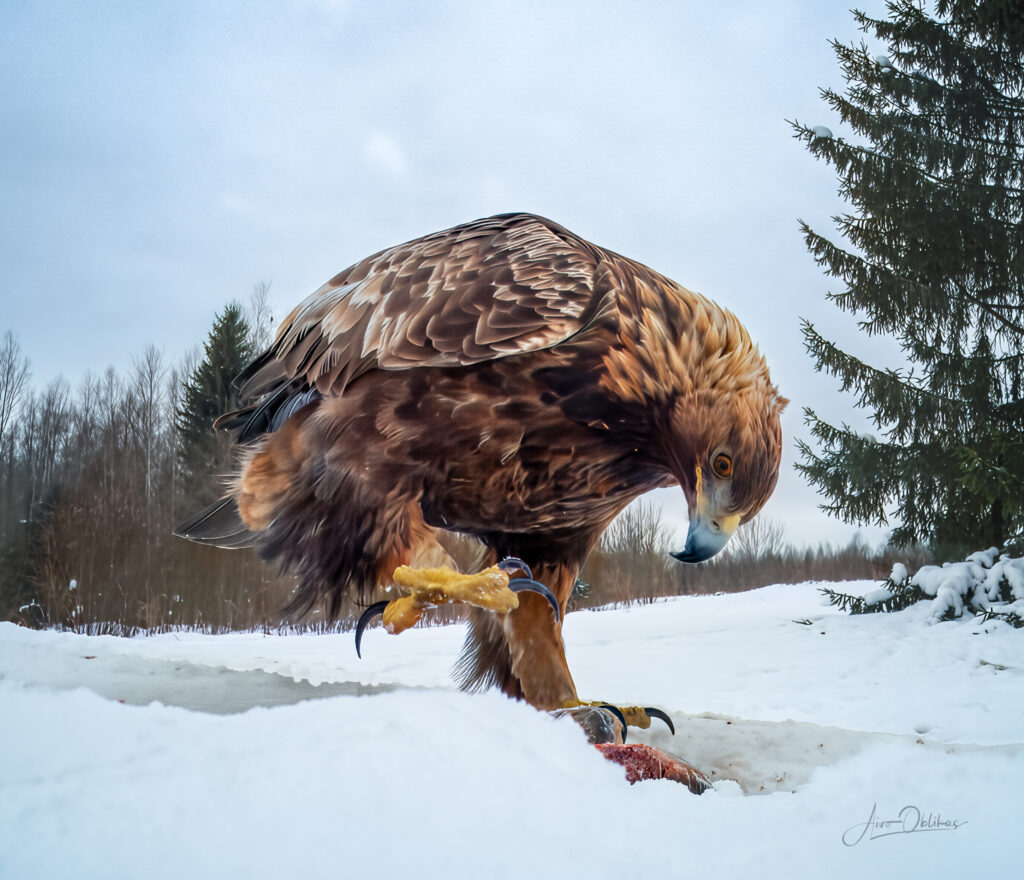
I get the photos
There are a lot of technical details in this whole previous story. When I look back on all this road today, it makes me smile how I have built and moved forward step by step. It’s kind of funny to think about how some details related to technology pop out one by one. In other words, you have to go through like one level first and then when you pass it, you will have the opportunity to experience what is missing and only then you can fix. And then you go through the next level, etc. It is not possible to experience things of next level on previous level. It is like computer game.
I have been training dogs for over 30 years and I really like to observe the behavior of the representatives of nature, interpret it, deduce it and try to learn more of the language of animals and birds. For me, these pictures of the golden eagle are just something on the road that I am especially happy about. It was awesome to feel in the status that I had read the King of the Birds so well that I had been able to outplay him.
If you look around in the picture groups of the rest of the world, very few birds of prey have been photographed with a wide lens. At first glance, I don’t want to prioritize myself in any way or in any way, so to speak. to be considered better. Everyone has their own path to follow and everyone is a master in their own way. This road has brought me joy and satisfaction.
Leave a Reply